
Managed IT vs. Break-Fix: Which Saves Small Businesses More in 2026?
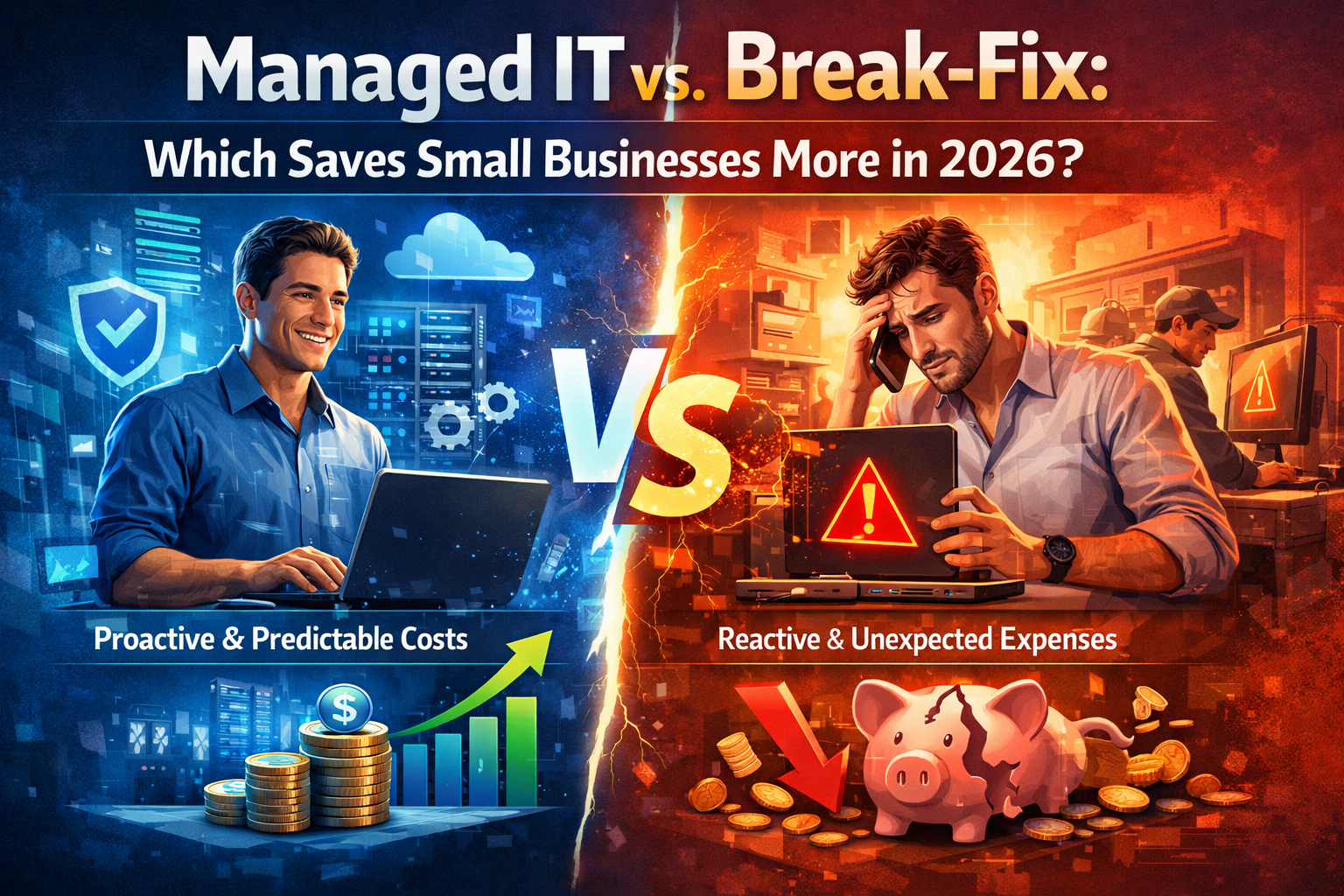
When something breaks, calling for help feels simple. You pay for the repair, move on, and hope the issue stays gone. That is the classic break-fix model.
For some very small businesses, that approach can work for a while. But as soon as your team depends on cloud apps, shared files, mobile devices, Wi-Fi, email, security tools, and remote access, “we’ll call when it breaks” starts acting less like a strategy and more like a trapdoor.
Managed IT takes a different approach. Instead of waiting for problems, it focuses on prevention, visibility, maintenance, and support before downtime spreads through your day.
So which model actually saves more in 2026? The honest answer is: it depends on how expensive downtime, risk, and lost momentum are to your business.
What Break-Fix Really Buys You
Break-fix support is reactive. You call when a computer stops working, a printer falls off the network, email goes sideways, or the internet becomes a collective office villain. The upside is easy to understand:
No monthly support agreement
Pay only when you need help
Good fit for one-off hardware issues or very small environments
The downside is just as real:
Problems are discovered late
No one is consistently watching your systems
Security gaps can sit unnoticed
Budgeting becomes unpredictable
Recurring issues keep coming back in different costumes
Break-fix often feels inexpensive because the invoice only arrives after an outage. What it does not show clearly is the cost of the hours your team lost while the problem was growing teeth.
What Managed IT Changes
Managed IT is built around ongoing support instead of emergency rescue. That usually includes some mix of monitoring, patching, helpdesk support, device oversight, security tooling, account management, vendor coordination, backup review, and planning.
The goal is not “never have issues again.” No provider can promise that. The goal is to catch problems earlier, shorten recovery time, reduce repeat failures, and keep your environment aligned with how your business actually operates. A managed relationship is especially valuable when:
Several employees rely on the same systems every day
You store sensitive business or customer information
Remote and in-office work both matter
You need predictable support costs
You want somebody accountable for the bigger picture
The Hidden Costs Most Owners Miss
When owners compare support models, they often focus only on service fees. That is understandable, but incomplete. A better comparison includes questions like these:
1. What does one hour of disruption cost us?
If your office cannot quote jobs, access files, answer phones, process payments, or send invoices, the cost is larger than the repair itself.
2. How often are staff working around annoying issues?
Slow computers, flaky Wi-Fi, printer chaos, login trouble, and recurring sync errors chip away at productivity. They do not always trigger an emergency ticket, but they still tax the business.
3. What happens when a security issue is missed?
A weak password habit, a missing patch, an ex-employee account left active, or an unmanaged phone might not create immediate drama. Then one day it does.
4. Are we paying more because nobody owns planning?
Without a roadmap, businesses tend to replace devices late, buy tools inconsistently, and solve each problem in isolation. That usually leads to higher long-term cost, not lower.
When Break-Fix Still Makes Sense
Let’s be fair to the old wrench in the drawer. Break-fix can still be reasonable when:
You have only a handful of devices
There is almost no shared infrastructure
Downtime has limited business impact
You already have internal technical oversight
Your environment is genuinely simple
If your team can function through occasional issues without major disruption, break-fix may be enough for now. But many businesses outgrow that phase before they admit it. The signs are usually obvious in hindsight.
Signs You’ve Outgrown Reactive Support
You are probably ready for managed IT if any of these sound familiar:
“The same issues keep coming back.”
“Nobody is sure who handles vendors, warranties, or renewals.”
“We’ve added staff, devices, and apps, but support is still improvised.”
“Security is important, but we are mostly hoping for the best.”
“When something breaks, the whole office feels it.”
That is the shift. IT stops being a few disconnected problems and becomes an operating system for the business itself.
Questions to Ask Before You Choose
Whether you stay reactive or move to managed support, ask these questions:
What is included every month versus billed separately?
Who handles vendor calls and escalations?
How are backups, patching, and endpoint security reviewed?
What happens after hours or during an outage?
Will we get recommendations, or only fixes?
How do you document our environment?
Good support should reduce chaos, not make you decode an invoice like ancient tablet fragments.
The Better Decision Is the One That Matches the Business You’re Running
If your company depends on reliable systems to make money, serve clients, and protect information, waiting for failures usually becomes the expensive option. Managed IT tends to save money not because nothing ever breaks, but because fewer things break badly, fewer issues linger, and fewer problems repeat.
Break-fix solves the moment. Managed IT protects the week, the quarter, and the year.
If your business is tired of reactive support and wants a clearer path forward, CCI can help you evaluate what level of coverage actually fits your environment. The goal is not to oversell you. It is to build an IT approach that keeps your team productive, secure, and much harder to derail.
📞 Call: 615-928-2438
🌐 Visit: www.cciustn.com