
Suspected Iran-Linked Cyberattack Targets 30+ Minnesota Water Systems: What Your Business Needs to Know
👾 CCI Hacker Headlines
Cyber News... You Can Actually Use
!!!!
Cyber News... You Can Actually Use !!!!
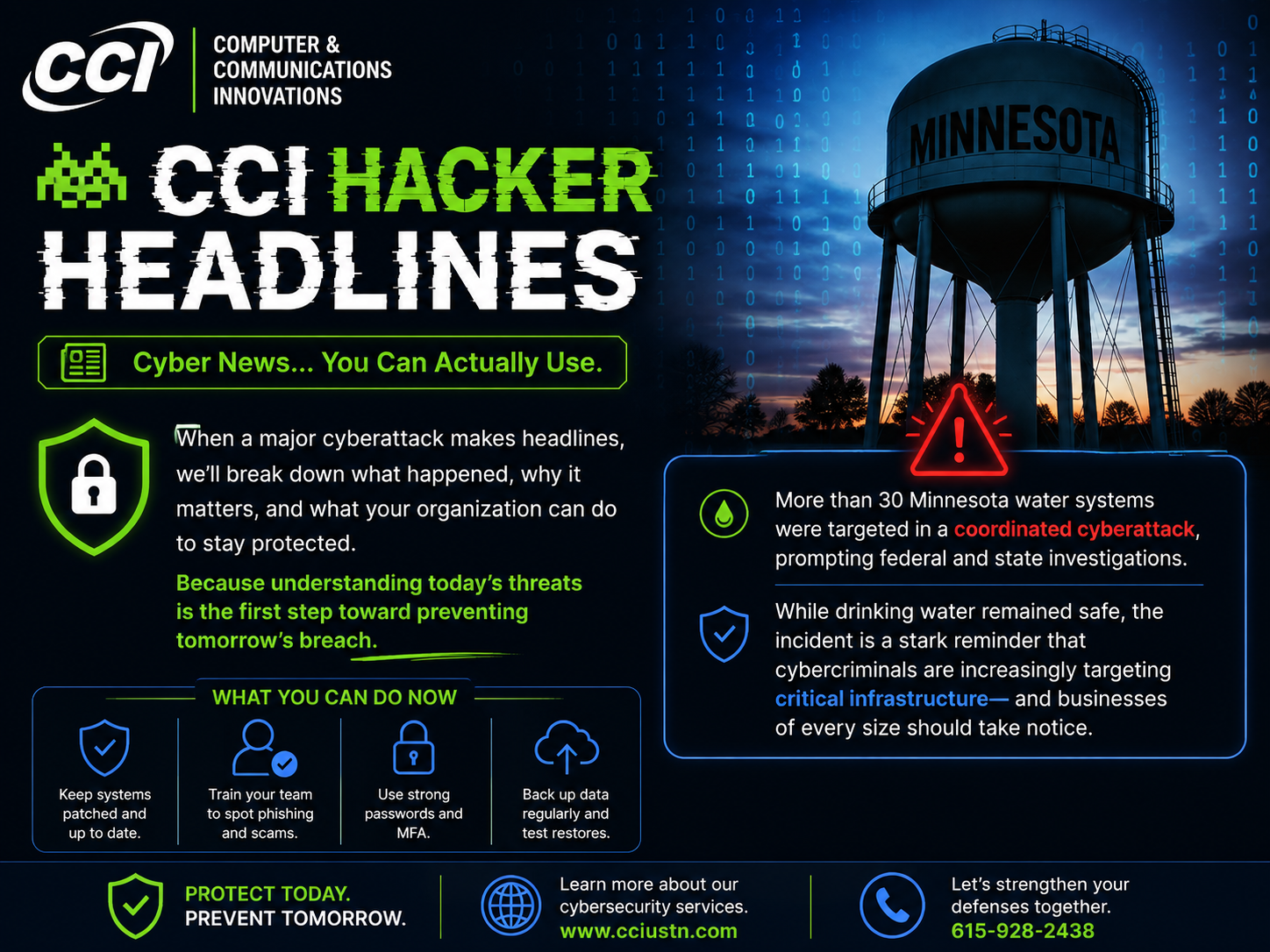
When most people think of cyberattacks, they picture stolen passwords, ransomware, or data breaches. This week, however, hackers set their sights on something far more critical—public water infrastructure.
Authorities are investigating a coordinated cyberattack that targeted more than 30 municipal water systems across Minnesota over a 48-hour period. While officials confirmed there was no impact to drinking water safety, several communities experienced disruptions to automated control systems and temporarily switched to manual operations while cybersecurity teams responded. Investigators believe the attacks may be linked to Iranian threat actors, although the investigation is still ongoing and attribution has not been officially confirmed.
What Happened?
The attacks focused on Operational Technology (OT)—the systems responsible for controlling pumps, treatment equipment, water towers, and other essential infrastructure.
In Braham, Minnesota, attackers temporarily disabled computerized operating controls, forcing the city's water treatment facility offline until operators restored service manually. Other municipalities, including Plymouth, South St. Paul, and Maple Plain, also reported cybersecurity incidents affecting water utility operations. Despite these disruptions, officials emphasized that water quality and public safety were never compromised.
Why This Matters
This wasn't simply an attack on a local utility—it was an attack on critical infrastructure.
Federal agencies have warned throughout the year that nation-state cyber groups are increasingly targeting water systems, energy providers, and other essential services because many rely on aging technology and internet-connected industrial control systems. Recent government advisories specifically warned of Iranian-affiliated actors attempting to compromise operational technology used by water utilities.
For businesses, this is another reminder that cyber threats are no longer limited to large corporations or government agencies.
What Every Business Can Learn
Whether you manufacture products, provide healthcare, run a nonprofit, or manage financial information, the same cybersecurity principles apply.
Ask yourself:
Is Multi-Factor Authentication (MFA) enabled on every critical account?
Are software updates and security patches installed promptly?
Do you know who has administrative access to your network?
Could your business continue operating if key systems suddenly became unavailable?
Are your backups tested and protected from ransomware?
Cybercriminals often look for the easiest target—not the biggest one.
CCI's Take
One of the biggest misconceptions about cybersecurity is that attackers only target organizations with valuable financial data.
The reality is that any connected system can become a target if it's vulnerable. Today's attack involved water infrastructure. Tomorrow's target could be a manufacturer, healthcare provider, school district, or local business.
Cybersecurity isn't just about protecting data anymore—it's about protecting operations.
What You Can Do Today
Here are five simple steps every organization should prioritize:
Enable Multi-Factor Authentication (MFA)
Keep operating systems and firmware up to date
Regularly review administrator accounts and permissions
Test backups and disaster recovery procedures
Partner with a trusted cybersecurity provider for continuous monitoring
Final Thoughts
The Minnesota water system attacks serve as another reminder that cybersecurity is now a matter of public safety and business continuity—not just IT.
Whether these attacks ultimately prove to be the work of Iranian-affiliated hackers or another sophisticated threat actor, one thing is clear: organizations can no longer afford to assume they're too small or too insignificant to be targeted.
At CCI, we help businesses stay ahead of emerging threats with proactive cybersecurity solutions, managed IT services, and expert guidance.