
When to Upgrade Network Cabling Instead of Blaming the Internet
Spot the warning signs of outdated office Wi-Fi before slow speeds, dropped calls, and device overload start costing your team time.
The internet gets blamed for a lot of crimes it did not commit.
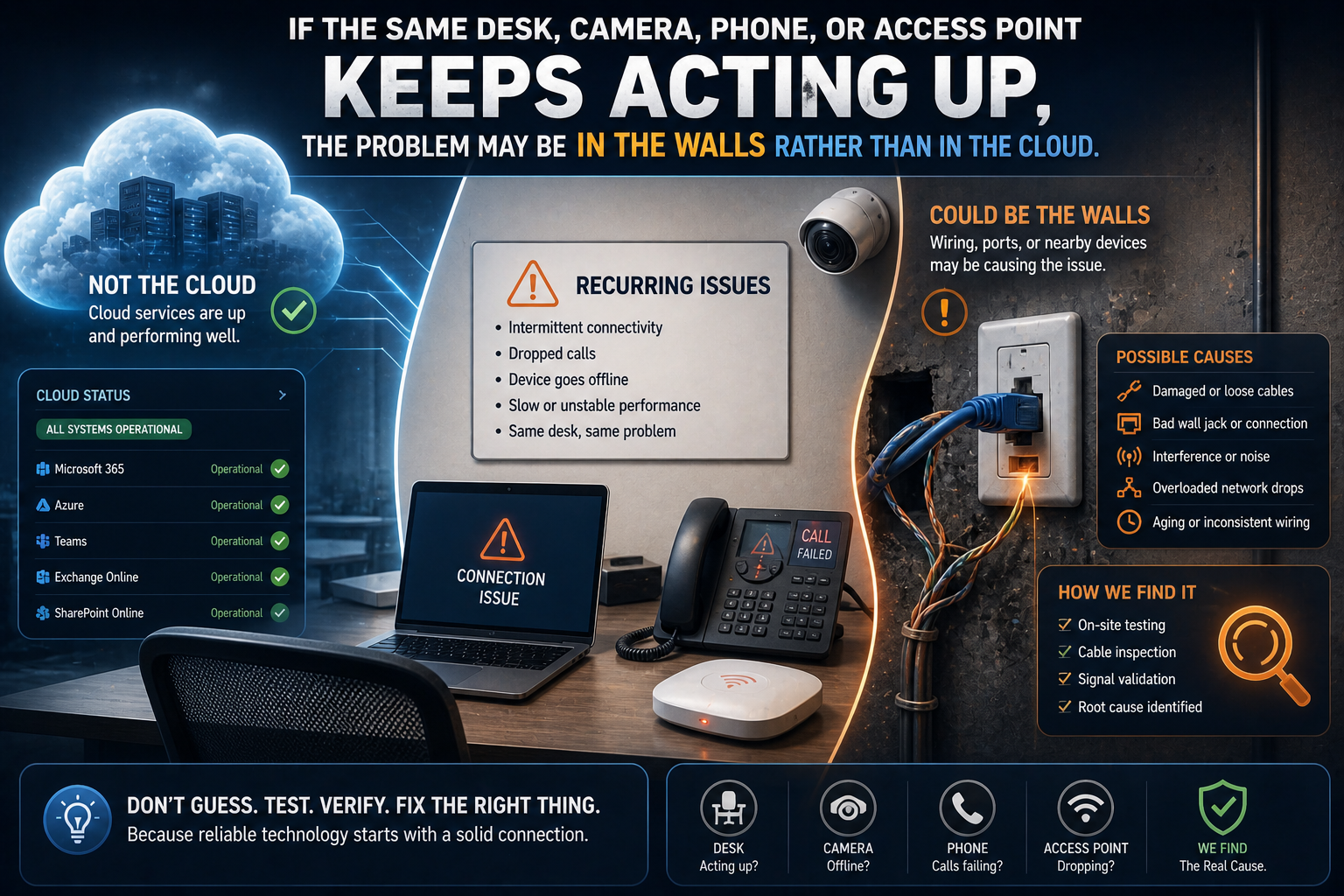
If calls drop, cameras stutter, printers disconnect, access points behave badly, or a workstation repeatedly loses connection, the first suspect is usually the provider. Sometimes that is fair. Other times the real culprit is much closer to home: the cabling.
Structured cabling is one of those business essentials that stays invisible when it is done right. Because it lives behind walls, above ceilings, and inside racks, it is easy to forget until problems begin multiplying.
When the cabling is old, inconsistent, damaged, poorly terminated, or mismatched to your current needs, the whole environment can feel unreliable.
The Signs Often Look Like “Random IT Problems”
Cabling issues rarely introduce themselves politely.
Instead, you may notice:
One desk that keeps dropping off the network
A phone system with intermittent quality issues
Access points that never seem stable
Security cameras with inconsistent performance
Links that negotiate poorly or underperform
Network closets that look like spaghetti took a management job
Because these symptoms mimic other network issues, businesses often spend time chasing devices, settings, or internet service when the real weakness is physical infrastructure.
Your Business May Have Outgrown the Original Cabling Plan
Maybe the space was cabled years ago for a smaller team. Maybe the office changed use. Maybe there are more access points, more cameras, more PoE devices, more conference rooms, or more traffic moving across the network than the original design anticipated.
Growth changes physical infrastructure requirements.
A cabling layout that once supported a few desks and a printer may now be asked to support:
VoIP phones
Wireless access points
Door access hardware
IP cameras
Shared displays
Conference tools
Denser workstation areas
Uplinks between network spaces
That is a different environment.
Performance Problems Are Not the Only Reason to Upgrade
Businesses sometimes think cabling should only be upgraded after obvious failures. But performance is only one reason.
Other reasons include:
Cleaner expansion for new devices or rooms
Better rack and closet organization
Easier troubleshooting
Improved labeling and documentation
Support for higher throughput needs
More reliable Power over Ethernet delivery
A messy physical layer tends to produce expensive support time because every change becomes harder than it should be.
The Physical Layer Affects Everything Above It
Good cabling supports:
Consistent switching
Reliable wireless backhaul
Cleaner camera performance
Stronger VoIP experience
Better access control stability
Easier moves, adds, and changes
Bad cabling adds drag to all of the above.
That is why network reliability is not only about what firewall or access point you bought. It is also about what those devices are standing on.
Questions Worth Asking
If you suspect the physical layer may be part of the issue, ask:
Are cable runs labeled and documented?
Are terminations clean and consistent?
Are network closets organized enough to troubleshoot quickly?
Are current cable types and patching aligned with our performance needs?
Are PoE-powered devices receiving stable power and data?
Have repeated trouble spots been traced back to specific runs or locations?
If the answer to several of those is unclear, a physical audit may be overdue.
Cabling Is Infrastructure, Not Decoration
Businesses sometimes postpone cabling improvements because it feels less visible than replacing endpoints or upgrading Wi-Fi. But infrastructure work often delivers some of the biggest reliability gains because it stabilizes everything else.
Think of it this way: polished devices on top of shaky cabling are like racing tires on a cart with one wobbly axle. They look serious, but the ride still goes sideways.
Upgrade with a Plan, Not a Panic
Not every environment needs a full recable. Sometimes targeted improvements solve the real issue. The important step is identifying whether the physical layer is limiting performance, complicating support, or preventing clean growth.
CCI helps businesses assess cabling conditions, clean up network infrastructure, and design structured systems that support today’s device load and tomorrow’s expansion. Because before you blame the internet again, it may be worth asking what the walls have been trying to tell you.
Upgrade with a Plan, Not a Panic
Not every environment needs a full recable. Sometimes targeted improvements solve the real issue. The important step is identifying whether the physical layer is limiting performance, complicating support, or preventing clean growth.
CCI helps businesses assess cabling conditions, clean up network infrastructure, and design structured systems that support today’s device load and tomorrow’s expansion. Because before you blame the internet again, it may be worth asking what the walls have been trying to tell you.
📞 Call: 615-928-2438
🌐 Visit: www.cciustn.com