
How to Build a Simple AI Policy for Your Small Business
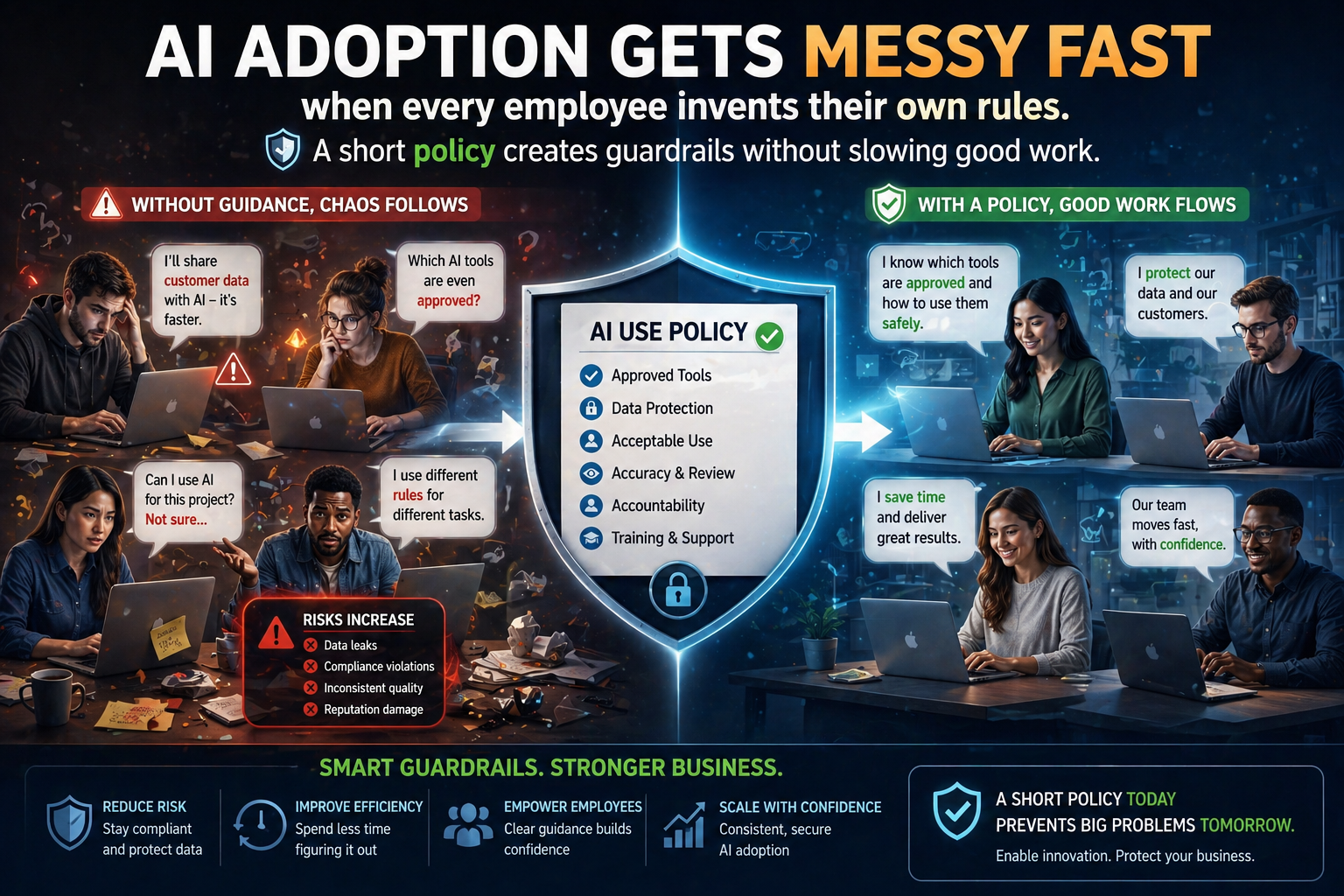
AI tools are already finding their way into business operations whether leadership has formally approved them or not.
Someone uses a chatbot to draft email copy. Someone else pastes notes into an AI meeting assistant. A manager experiments with summarizing spreadsheets. Marketing tries image generation. Customer service tests suggested replies. It starts small and spreads quietly.
That does not mean AI is a bad fit. It means your business needs rules before habits harden into risk.
The good news is that an effective AI policy does not need to be a 27-page monument to legal dread. For most small businesses, a clear one-page policy is far better than no policy at all.
Why You Need a Policy Before AI Gets Everywhere
Without guidance, teams tend to make their own assumptions about:
What tools are approved
What data can be pasted into AI systems
Whether outputs can be used as-is
Who is responsible for accuracy
How client or employee information should be handled
That creates inconsistency and avoidable risk.
A short policy gives employees useful guardrails without killing experimentation.
Start with Approved Use Cases
The easiest way to make AI adoption safer is to define where it is appropriate first.
Examples might include:
Drafting first-pass marketing copy
Summarizing meeting notes
Brainstorming outlines or ideas
Reformatting internal documents
Generating non-sensitive templates
Assisting with repetitive admin tasks
When people know where AI is welcome, they are less likely to use it recklessly in places where it should not be.
Define What Must Never Be Entered
This is the line most businesses need to draw in thick marker.
Your policy should clearly identify information that should not be entered into unapproved AI tools, such as:
Confidential client data
Protected financial information
Employee records
Legal documents
Credentials or access details
Proprietary internal information
Anything covered by contractual or regulatory obligations
A useful rule of thumb: if you would not want the text copied into a public training wall, do not paste it into an unapproved tool.
Require Human Review
AI can accelerate work. It should not silently become the final authority.
Your policy should say that AI-generated content must be reviewed by a human before it is sent, published, or relied on for business decisions.
That applies especially to:
Customer-facing communication
Policy or HR language
Technical instructions
Financial summaries
Legal or compliance-related writing
Anything that could create trust damage if wrong
The goal is not to distrust every output. It is to keep accountability human.
Keep the Tool List Simple
Do not leave employees guessing which platforms are allowed.
Your policy should name:
Approved tools
Restricted tools
Who can request a new tool
Who reviews data-handling concerns
How licenses or access are managed
This prevents “I just used the first thing I found” from becoming your unofficial AI strategy.
Clarify Ownership and Recordkeeping
If AI is used to help create a deliverable, who owns the final review? Where should outputs be stored? Can they be copied into customer systems? Should prompts or results be retained for certain workflows?
You do not need to answer every theoretical question on day one. You do need enough clarity that employees know how to work responsibly.
Train for Judgment, Not Just Compliance
The strongest AI policy is supported by examples.
Show teams:
A safe use case
A risky use case
A clearly prohibited use case
A good example of human review
A bad example of trusting AI too quickly
When people can see the difference, adoption gets smarter fast.
Keep the Policy Short Enough to Be Used
A bloated policy gets ignored. A short policy gets referenced.
A practical small-business AI policy can often fit into sections like:
Purpose
Approved tools
Allowed use cases
Restricted data
Human review requirement
Security and privacy expectations
Questions and escalation path
That is enough to create a fence without building a maze.
AI Works Better with Guardrails Than with Guessing
Businesses do not need to fear AI, but they do need to govern it. The sooner you give your team a clear, usable framework, the easier it is to capture the upside without inviting unnecessary risk.
AI adoption is much easier to shape early than to unwind later after a few bad habits, bad prompts, or bad assumptions have already settled in.
CCI helps businesses evaluate AI opportunities, define practical policies, and choose tools that fit real operations. Because the best AI strategy is not “everyone do whatever.” It is “let’s use this well, on purpose, and with our eyes open.”
📞 Call: 615-928-2438
🌐 Visit: www.cciustn.com